
Glorious Madness - The Old Course in Reverse
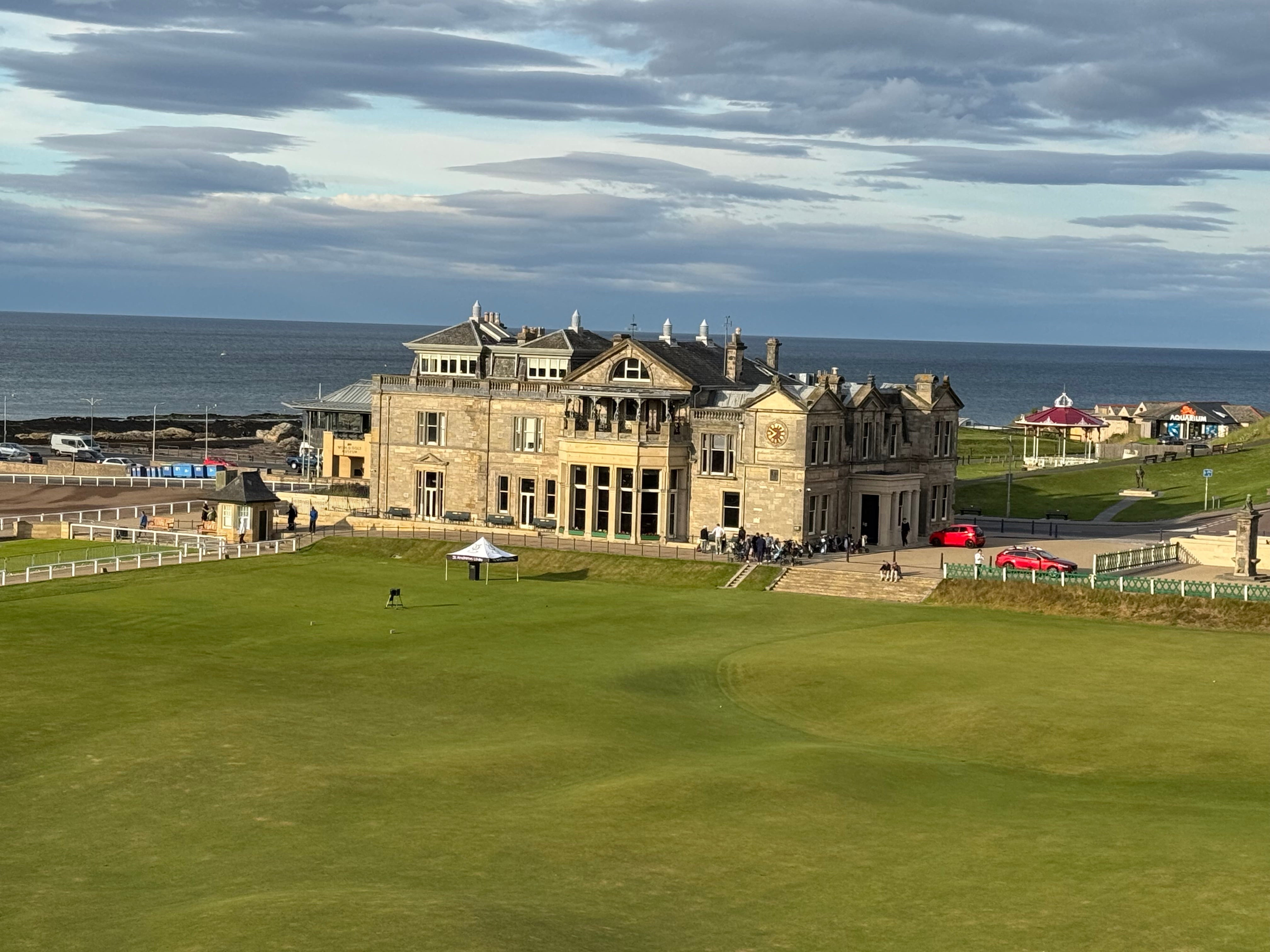
As an experienced caddy at St Andrews, Sam Hill has helped guide hundreds of golfers around the most famous course in the world. But when the Links Trust opened up the history reverse routing, he experienced The Old Course in a completely new way.
Ever since I started caddying at the Old Course, I’ve thought about what it would be like to caddie on the original Old Course, the Oldest Course, if you will. I’ve thought about what it would be like to get into a time machine with my player and head back to the nineteenth century. How would I plot them around what is essentially a ‘lost’ golf course?
Walking down the first fairway of a new loop, I often glance to my left at the Road Hole green and smile, thinking to myself: "Could you imagine hitting your first iron shot of the day into THATgreen?"
Last month, I was fortunate enough to watch my player do exactly that. I caddied not once but twice on the Old Course Reversed. It was a breathtaking, chaotic, confusing, extraordinary, and truly one-of-a-kind experience, and I felt I needed to write about it.
The History
Trying to explain what the Old Course in Reverse is to someone who doesn’t know a lot about golf - hell, even someone who does - feels like trying to describe the plot of TENET to someone, but I’m going to give it a go.
The majority of the holes on the Old Course feature shared fairways and greens, which allows the reverse Old Course to use the same land as the routing that everyone knows and loves. For both routings, you start your round on the first tee while finishing on the 18th green. Everything in between, though, goes in opposite directions.
For example, instead of hitting your first approach into the first green, you hit into the seventeenth. Instead of walking to the second tee box after you finish your first hole, you walk to the eighteenth, from where you play to the sixteenth green. From there, the numbers become quite easy to follow, on paper at least - other than the last hole, the green you’re hitting to is always two less than the tee box you teed off from.
Even after my flawless explanation, you may still be thinking: “What is this tosser talking about?” And that would be a totally fair question to have.
But it may make more sense when I tell you that the Old Course in reverse is the first ever eighteen-hole golf course. This isn’t a concept created in a St Andrews Links Trust marketing meeting. The current-reversed routing is how the golf course was originally played when the Royal and Ancient (R&A) Golf Club of St Andrews reduced the course from 22 holes to 18 in 1764.
About a century later, Old Tom Morris first put his stamp on the land when he separated the first and seventeenth greens, which left the course with the seven double greens and four single greens that exist on the present-day Old Course. This opened up the option to play the course in a counterclockwise routing as well.
The two routings were rotated week-by-week for a few decades for agronomic reasons, but over time, it became clear that the current Old Course routing was the preferred way to play the course. The clockwise routing was used sparingly until the 1970’s, when it was no longer used at all, except for a few one-off instances over the past five decades.
By then, the popularity and notoriety of the routing used on the Old Course for the Open Championship, along with advancements in golf course maintenance, meant that the anti-clockwise routing was used year-round.
However, absence makes the heart grow fonder, and for generations of golfers obsessed with the Old Course, the thought of playing the original routing, where the game as we know it well and truly began, was too special to let go of.
Thankfully, the Links Trust found a way to make their dreams a reality and, as far as I know, will be giving people the opportunity to play with the reversed routing for one weekend every April.
That's the history lesson out of the way. If you want to read a hole-by-hole analysis of the Old Course in Reverse from a caddie's perspective, please see the full version of this piece on Sam's Substack.
Overall thoughts
After caddying for two players around the clockwise routing, I felt the reversed front nine was much superior to the reversed back nine.
Simply put, it just made a lot more sense. It felt like we were on a much more natural, proper golf course, with different ways to play each hole and an array of rewards and consequences depending on the path you played them. Essentially, it felt like the Old Course should feel.
Some of the holes home coming, by contrast, felt quite claustrophobic and squeezed, which I didn’t know was possible on the Old Course.
Helping my player play holes like 12, 13, and 16 was like trying to put square pegs into round holes. With little fairway to aim at directly in line with the flag and too much rough short of the greens, the holes felt one-dimensional.
This issue stems from the fact that the mowing lines on the holes are not cut with the intention of making the reversed routing as playable as possible.
Still, the back nine holes showed me new sightlines and presented challenges that gave me a better awareness of the full scale of many of the greens on the traditional front nine.
It was enlightening seeing greenside bunkers play in a completely different way, but still dictate how you wanted to attack the hole.
I have walked the Old Course hundreds of times, and yet I feel like I understand it so much better now that I’ve seen it in reverse.
Purely from a logistical standpoint, it was amazing to see the reverse Old Course work as a legitimate golf course without seeming gimmicky or contrived. I mean, think about it, you’re playing a fucking golf course backwards, it sounds like a very convoluted experiment. But it didn’t present that way at all.
The Links Trust and the grounds crew did a remarkable job of making everything run smoothly and ensuring everyone got around safely.
The Experience
The experience while on course was extremely chaotic. I have never heard as many people shouting FORE on a golf course as I did during the Old Course Reversed. Yet there was order in the chaos, and a mutual understanding among everyone on the course that no one really had any idea what was going on.
When caddying on the Old Course, there’s obviously a pretty large gap between our knowledge of the course and our players’ knowledge. There aren’t many things you haven’t seen out there.
But on the reversed routing, we’re pretty much figuring things out with our player on the fly, one hole at a time. They’ve never seen this golf course before, and neither have I. We’re figuring out how to plot our way around this thing together, a course that few people who are still alive have played, creating our own small piece of history in doing so.
Neither of the players I caddied for cared about their score or their handicap. Yes, they wanted to hit good shots and make a few birdies, but The Old Course in Reverse strips golf down, removes expectations, and reminds you why you started playing the game in the first place.

The author with his friend Andrew on the first tee
The first player I caddied for on the Old Course reverse was Andrew, who is a friend of mine from Toronto. He had played the course the traditional way for the first time the day before, and playing it in reverse less than 24 hours later, he was blown away by how the puzzle pieces fit together so seamlessly.
The classic advice we give first-timers on the Old Course is simple: Left is right, and right is shite.” There's almost always plenty of open space to the left off the tee.
On the reverse routing, it's the opposite, and Andrew and I spent much of the round taking full advantage of the right side of the golf course. This left us with some thought-provoking approach shots into greens - we played the 12th hole with a four iron of the tee followed by another into the green.
Seeing the course in reverse for the first time with someone I was comfortable with, like Andrew, was helpful. He fully understood that I had never seen this course in this direction before and that we were going to figure it out on the fly together.
We had a blast comparing and contrasting the holes on the normal routing with those on the reverse, wondering what the best 18-hole course we could make from the two combined routings would be.
The round with Andrew made me feel so much more at ease for my next round on the reverse. My second player had never played the course in either direction, so he could not have been more confused for the first couple of holes.
But as we got deeper into the round and I explained to him how the courses work in tandem and how the placement of bunkers affects the two routings differently, he began to understand the importance of tee shot placement and how to attack greens from the right angles.
By the end of the round, he told me that he was happy he got to play it the reversed way before the normal Old Course, because he’d have a greater appreciation for the strategy and intricacy of the counter-clockwise routing when he did eventually play it.
The shared adventure with both of the players I caddied for was so rewarding for me. One a buddy, and one that I’d never met before.
That’s something golf holds in its essence that is becoming rarer and rarer these days. Being able to build relationships, create new memories and share experiences with your friends, yes, but also with strangers who love the game just like you do.
There’s a line in that film I referenced earlier, TENET, that encapsulates the experience of the Old Course in reverse perfectly. In trying to explain inverted entropy (don’t ask) to the Protagonist, the scientist pleads with him: “Don’t try to understand it, feel it.”
Now, I realize I’ve just tried to explain to you the technical merits of the reversed routing, but I think the quote gets at the heart of why I enjoyed the Old Course in reverse so much beyond its qualities as a golf course.
Much like the entire town of St Andrews, there are emotions that the experience conjures, which can be hard to articulate.
It’s the feeling of being humbled by history, nostalgic for a time you’ve never experienced. It's thinking back to 1825, and trying to wrap your head around the fact that despite everything that has changed in the world over those 200 years, this golf course, more or less, exists today the same as it did then. It will always exist as it did then.
As silly as it may seem to some people to attach such meaning to a golf course, there’s great comfort in knowing the permanence of a place like the Old Course.
That’s why I dropped everything and travelled to another continent to work here, it’s why the tee sheet is full every single day, why golfers from 63 different countries applied to play the Old Course in Reverse, and why Tiger Woods has said he wants to play it backwards one time before he dies. This piece of golfing land is magical, and anyone who’s been here will attest to that.
Everything about this place reminds me that everything I’ve put into golf is worth it.
The money I’ve spent on rounds and balls and clubs. The hours I’ve waited on tee boxes hoping the group ahead will pick up the pace so we can get 18 holes in before dark. The dozens of golf course architects whose golf courses I’ve tried to learn every single detail. And, of course, the relationships that have been created or deepened through this game.
Spending time in St Andrews is the ultimate reward for all of that.
The Old Course in reverse is a fantastic golf course, a work of art, and an integral part of golf history. But more than that, it’s a much-needed reminder of why we love golf so much in the first place.
Put the ball on a tee, aim at the flag that you may or may not be able to see with a big smile on your face, and have some fun.
"Where else in the world do we find a course to which all great players journey and where all ages and abilities meet and praise with equal fervor?"
Robert Hunter on the Old Course